
Commercial Chiller vs Freezer: Which Does Your Business Need?
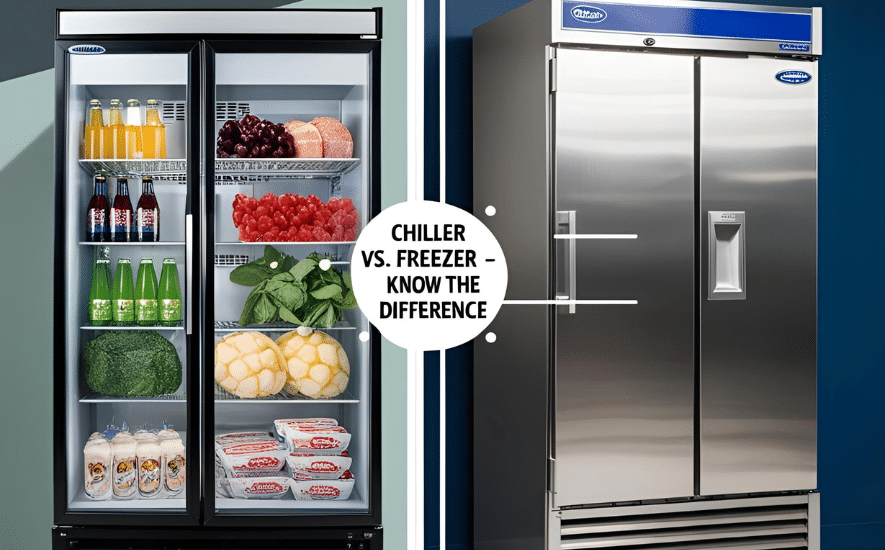
Chillers and freezers are both refrigeration equipment, but they are designed for different product conditions and storage objectives. Choosing the wrong type can affect food quality, storage life, energy use, and operational workflow. This guide explains how to decide which one your business actually needs.
Quick selection checklist
| Chiller | Maintains products above freezing at a controlled chilled condition appropriate to the product and application. |
|---|---|
| Freezer | Maintains products in a frozen condition for frozen storage/display applications. |
| Display chiller | Combines chilled holding with customer-facing presentation. |
| Display freezer | Combines frozen holding with merchandising access/visibility. |
| Cold room | Custom room-size chilled or frozen storage for larger inventories or production operations. |
1. Start with the required product condition
Ask whether the product must remain chilled, frozen, or simply cooled for service. Fresh produce, beverages, dairy, meat, frozen foods, and ice cream all have different storage/display requirements. The product specification and food-safety plan should determine the temperature requirement.
2. Storage duration changes the equipment choice
Short-term service holding, daily retail display, and longer-term stock storage may use different refrigeration formats. A reach-in chiller can be ideal for kitchen access while a display case is designed for merchandising; a cold room may be more efficient for larger stock volumes.
3. Display equipment and storage equipment have different priorities
Customer-facing cabinets emphasize visibility and access, which can increase heat gain compared with closed storage equipment. Storage units typically prioritize capacity and temperature stability. Decide whether the equipment is primarily for selling, serving, or storing product.
4. Freezing requires a different refrigeration duty
Freezer systems generally operate at lower evaporating temperatures and can face greater refrigeration load, insulation, and defrost demands. Do not assume a chiller can simply be turned down to become a freezer unless the equipment was designed for that duty.
5. Energy use depends on the whole application
Temperature level, door/open-display design, ambient heat, condenser ventilation, insulation, loading, and maintenance all influence energy consumption. Comparing only compressor wattage gives an incomplete picture.
6. When a cold room makes sense
If daily stock volume is large or many individual cabinets would be required, a properly designed cold room can centralize chilled or frozen storage. The design should be based on room size, product load, incoming temperature, and usage pattern.
7. What to tell the supplier
Provide product type, required temperature, quantity/volume, display versus storage purpose, daily loading, installation location, ambient conditions, and available power. This helps determine whether a chiller, freezer, display case, or cold room is appropriate.
8. Quotation checklist
For a more accurate quotation, share the intended application, capacity or daily load, required dimensions, operating temperature where relevant, available power and utilities, installation location, project timeline, and any layout or site photos. Clearly state whether you need equipment supply only or installation/commissioning support.
Use Request a Quote for commercial pricing or Talk to an Engineer when the project needs technical review.
Frequently asked questions
Can a commercial chiller be used as a freezer?
Only if the specific equipment is designed and rated for freezer duty. Chillers and freezers can use different refrigeration capacities, controls, insulation, and defrost arrangements.
Which is better for a supermarket: a chiller or a freezer?
Most supermarkets need both. Chillers serve fresh/chilled categories, while freezers serve frozen products. The product assortment determines the mix.
Is a display refrigerator the same as a storage refrigerator?
Not necessarily. Display equipment is designed for visibility and customer/staff access, while storage equipment often prioritizes capacity and temperature stability.
When should I consider a cold room?
A cold room can be appropriate when stock volume, receiving frequency, or operational workflow makes multiple individual cabinets inefficient or insufficient.
Need a project-specific recommendation?
Explore Chiller & Freezer Equipments and Display Refrigeration, or send GTON your requirement for a technical and commercial proposal.